Ficheiro:Kepler186f-ComparisonGraphic-20140417 improved.jpg




Descrição do ficheiro
| Descrição |
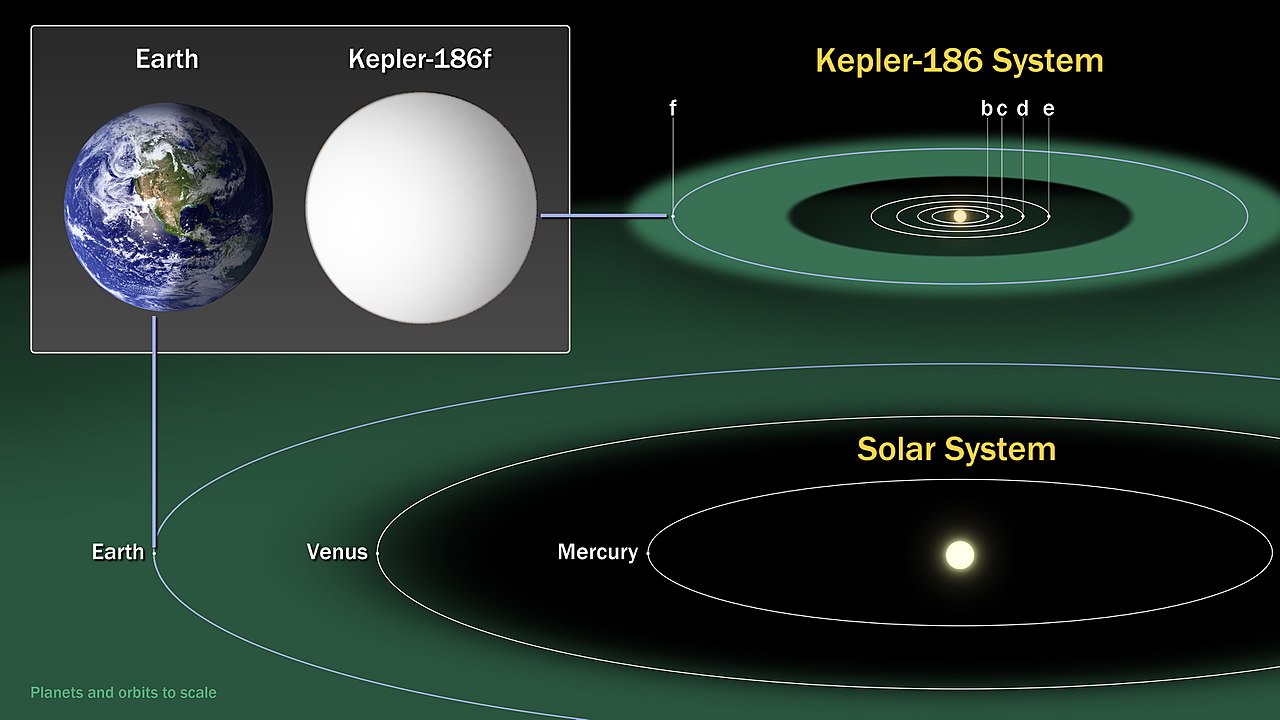
English: Kepler-186 and the Solar System
http://www.nasa.gov/ames/kepler/kepler-186-and-the-solar-system http://www.jpl.nasa.gov/news/news.php?release=2014-119 http://www.jpl.nasa.gov/spaceimages/details.php?id=PIA18000 The diagram compares the planets of our inner solar system to Kepler-186, a five-planet star system about 500 light-years from Earth in the constellation Cygnus. The five planets of Kepler-186 orbit an M dwarf, a star that is is half the size and mass of the sun. The Kepler-186 system is home to Kepler-186f, the first validated Earth-size planet orbiting a distant star in the habitable zone—a range of distance from a star where liquid water might pool on the planet's surface. The discovery of Kepler-186f confirms that Earth-size planets exist in the habitable zones of other stars and signals a significant step toward finding a world similar to Earth. The size of Kepler-186f is known to be less ten percent larger than Earth, but its mass and composition are not known. Kepler-186f orbits its star once every 130 days, receiving one-third the heat energy that Earth does from the sun. This places the planet near the outer edge of the habitable zone. The inner four companion planets each measure less than fifty percent the size of Earth. Kepler-186b, Kepler-186c, Kepler-186d and Kepler-186e, orbit every 4, 7, 13 and 22 days, respectively, making them very hot and inhospitable for life as we know it. The Kepler space telescope infers the existence of a planet by the amount of starlight blocked when it passes in front of its star. From these data, a planet's radius, orbital period and the amount of energy recieved from the host star can be determined. This derived version does not make any speculative assumptions of the actual appearance planet Kepler-186f itself, which therefore is displayed by a white ball, in deviation of the artistic and imaginative view of the original picture. |
| Data | |
| Origem |
Este ficheiro foi derivado de: Kepler186f-ComparisonGraphic-20140417.jpg:  |
| Autor | NASA Ames/SETI Institute/JPL-Caltech |
Licenciamento

|
Este ficheiro está no domínio público nos Estados Unidos porque foi criado exclusivamente pela NASA. As orientações sobre o direito de autor da NASA são que «as obras da NASA não têm os direitos de autor protegidos salvo indicação em contrário». Veja Template:PD-USGov, as orientações sobre o direito de autor da NASA ou as normas de uso de imagens do Laboratório de Propulsão a Jato (Jet Propulsion Lab, JPL). |  |
 |
Avisos:
|

For the changes made in this derivative work by user:Karl432 applies:
 
|
A utilização deste ficheiro é regulada nos termos Creative Commons - CC0 1.0 Dedicação Universal ao Domínio Público. |
| A pessoa que associou uma obra a este documento dedicou-a ao domínio público, renunciando a todos os seus direitos sobre a obra em todo o mundo ao abrigo da legislação de direitos de autor, incluindo a todos os direitos legais conexos, na medida permitida por lei. Pode copiar, modificar, distribuir e executar a obra, até com fins comerciais, sem pedir autorização.
|
Histórico do ficheiro
Clique uma data e hora para ver o ficheiro tal como ele se encontrava nessa altura.
| Data e hora | Miniatura | Dimensões | Utilizador | Comentário | |
|---|---|---|---|---|---|
| atual | 00h36min de 18 de abril de 2014 | | 4 534 × 2 550 (925 kB) | wikimediacommons>Karl432 | User created page with UploadWizard |
Utilização local do ficheiro
A seguinte página usa este ficheiro:
