Ficheiro:Newton optimization vs grad descent.svg
Saltar para a navegação
Saltar para a pesquisa
Dimensões desta antevisão em PNG do ficheiro SVG: 521 × 600 píxeis Outras resoluções: 208 × 240 píxeis | 417 × 480 píxeis | 667 × 768 píxeis | 889 × 1 024 píxeis | 1 779 × 2 048 píxeis | 813 × 936 píxeis.


Ficheiro original (ficheiro SVG, de 813 × 936 píxeis, tamanho: 48 kB)

| Descrição |
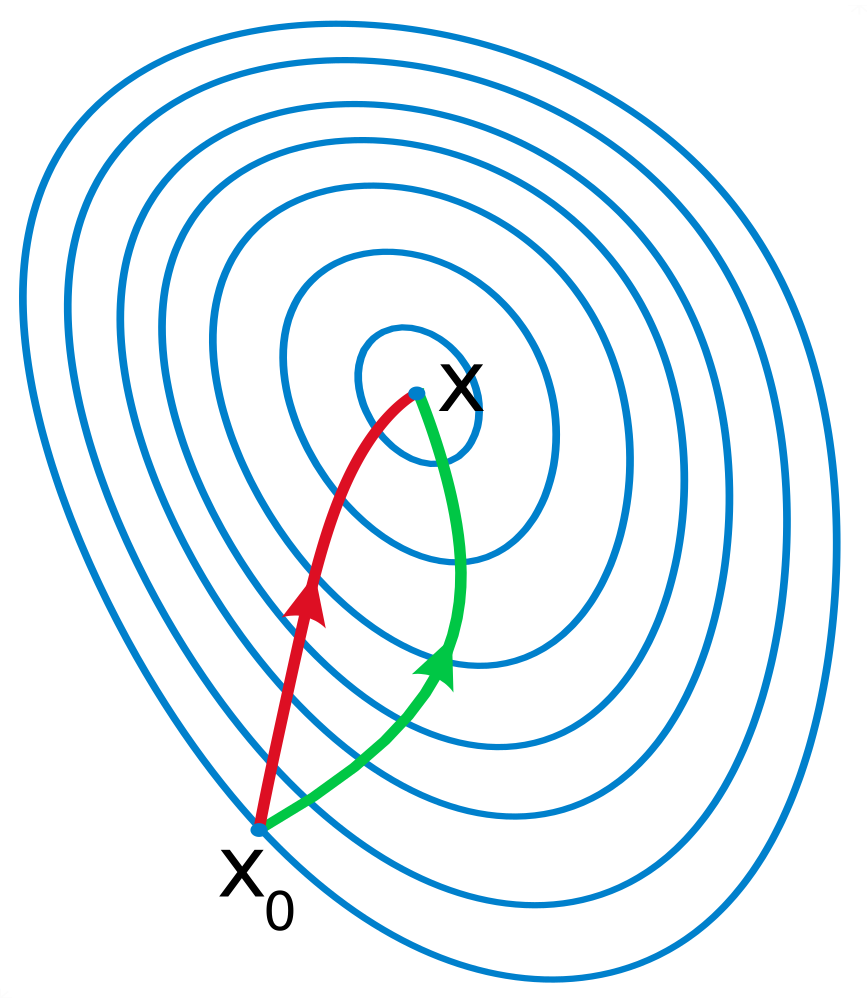
English: A comparison of gradient descent (green) and Newton's method (red) for minimizing a function (with small step sizes). Newton's method uses curvature information to take a more direct route.
Polski: Porównanie metody najszybszego spadku(linia zielona) z metodą Newtona (linia czerwona). Na rysunku widać linie poszukiwań minimum dla zadanej funkcji celu. Metoda Newtona używa informacji o krzywiźnie w celu zoptymalizowania ścieżki poszukiwań. |
| Data | (UTC) |
| Origem | self-made with en:Matlab. Tweaked in en:Inkscape |
| Autor | Oleg Alexandrov |

|
Eu, titular dos direitos de autor desta obra, dedico-a ao domínio público, com aplicação em todo o mundo. Nalguns países isto pode não ser legalmente possível; se assim for: Concedo a todos o direito de usar esta obra para qualquer fim, sem quaisquer condições, a menos que tais condições sejam impostas por lei. |
Source code
% Comparison of gradient descent and Newton's method for optimization
function main()

% the ploting window
   figure(1); clf; hold on; axis equal; axis off;

% colors
   red=[0.867 0.06 0.14];
   blue = [0, 129, 205]/256;
   green = [0, 200,  70]/256;
   black = [0, 0, 0];
   white = 0.99*[1, 1, 1];

% graphing settings
   lw=3; arrowsize=0.06; arrow_type=2;
   fs=13;

% the function whose contours will be plotted, and its partials
   C = [0.2, 4, 0.4, 1, 1.5]; % Tweak f by tweaking C
   f=inline('(C(1)*(x-0.4).^4+C(2)*x.^2+C(3)*(y+1).^4+C(4)*y.^2+C(5)*x.*y-1)', 'x', 'y', 'C');
   fx=inline('(4*C(1)*(x-0.4).^3+2*C(2)*x+C(5)*y)', 'x', 'y', 'C');
   fy=inline('(4*C(3)*(y+1).^3+2*C(4)*y+C(5)*x)', 'x', 'y', 'C');

   fxx=inline('(12*C(1)*(x-0.4).^2+2*C(2))', 'x', 'y', 'C');
   fxy=inline('C(5)', 'x', 'y', 'C');
   fyy=inline('(12*C(3)*(y+1).^2+2*C(4))', 'x', 'y', 'C');

   plot_contours(f, C, blue, white, lw);

% step size
   alpha=0.025;

% initial guess
   V0=[-0.2182,  -1.2585];
   x=V0(1); y = V0(2);
   z=x; w=y;

   % run several iterations of gradient descent and Newton's method
   X=[x]; Y=[y]; Z = [z]; W=[w];
   for i=0:200

      % grad descent
      u=fx(x, y, C);
      v=fy(x, y, C);

      x=x-alpha*u; y=y-alpha*v;
	  X = [X, x]; Y = [Y, y];

      % newton's method
      u=fx(z, w, C);
      v=fy(z, w, C);
      mxx=fxx(z, w, C);
      mxy=fxy(z, w, C);
      myy=fyy(z, w, C);
      M = [mxx, mxy; mxy, myy];

      V = M\[u; v];
      u = V(1);
      v = V(2);

      z=z-alpha*u; w=w-alpha*v;
	  Z = [Z, z]; W = [W, w];

   end

   plot(X, Y, 'color', green, 'linewidth', lw);
   plot(Z, W, 'color', red,   'linewidth', lw);


% plot text
   small = 0.03;
   m = length(Z); V = [Z(m), W(m)];
   text(V0(1)-2*small, V0(2)-2*small, 'x_0', 'fontsize', fs);
   text(V(1)+small, V(2)+small, 'x', 'fontsize', fs);

% some small balls, to hide some imperfections
   small_rad= 0.015;
   ball(V0(1),V0(2), small_rad, blue);
   ball(V(1),V(2),   small_rad, blue);

% save to eps ans svg
   saveas(gcf, 'Newton_optimization_vs_grad_descent.eps', 'psc2')
%   plot2svg('Newton_optimization_vs_grad_descent.svg')

function plot_contours(f, C, color, color2, lw)

   % Calculate f on a grid
   Lx1=-2; Lx2=2; Ly1=-2; Ly2=2;
   N=60; h=1/N;
   XX=Lx1:h:Lx2;
   YY=Ly1:h:Ly2;
   [X, Y]=meshgrid(XX, YY);
   Z=f(X, Y, C);

% the contours
   h=0.3; l0=-1; l1=0.7;
   l0=h*floor(l0/h);
   l1=h*floor(l1/h);
   Levels=-[l0:1.5*h:0 0:h:l1 0.78];


% Plot the contours with 'contour' in figure(2), and then with 'plot' in figure(1).
% This is to avoid a bug in plot2svg, it can't save output of 'contour'.
   figure(2); clf; hold on; axis equal; axis off;
   xmin = 1000; ymin = xmin; xmax = -xmin; ymax = -ymin;
   for i=1:length(Levels)

      figure(2);
      [c, stuff] = contour(X, Y, Z, [Levels(i), Levels(i)]);

      [m, n]=size(c);
      if m > 1 & n > 0

      % extract the contour from the contour matrix and plot in figure(1)
		 l=c(2, 1);
		 x=c(1,2:(l+1));  y=c(2,2:(l+1));
		 figure(1); plot(x, y, 'color', color, 'linewidth', 0.66*lw);

		 xmin = min(xmin, min(x)); xmax = max(xmax, max(x));
		 ymin = min(ymin, min(y)); ymax = max(ymax, max(y));
      end
   end
   figure(1);

% some dummy text, to expand the saving window a bit
   small = 0.04;
   plot(xmin-small, ymin-small, '*', 'color', color2);
   plot(xmax+small, ymax+small, '*', 'color', color2);


function arrow(start, stop, thickness, arrow_size, sharpness, arrow_type, color)

% Function arguments:
% start, stop:  start and end coordinates of arrow, vectors of size 2
% thickness:    thickness of arrow stick
% arrow_size:   the size of the two sides of the angle in this picture ->
% sharpness:    angle between the arrow stick and arrow side, in radians
% arrow_type:   1 for filled arrow, otherwise the arrow will be just two segments
% color:        arrow color, a vector of length three with values in [0, 1]

% convert to complex numbers
   i=sqrt(-1);
   start=start(1)+i*start(2); stop=stop(1)+i*stop(2);
   rotate_angle=exp(i*sharpness);

% points making up the arrow tip (besides the "stop" point)
   point1 = stop - (arrow_size*rotate_angle)*(stop-start)/abs(stop-start);
   point2 = stop - (arrow_size/rotate_angle)*(stop-start)/abs(stop-start);

   if arrow_type==1 % filled arrow

% plot the stick, but not till the end, looks bad
      t=0.5*arrow_size*cos(sharpness)/abs(stop-start); stop1=t*start+(1-t)*stop;
      plot(real([start, stop1]), imag([start, stop1]), 'LineWidth', thickness, 'Color', color);

% fill the arrow
      H=fill(real([stop, point1, point2]), imag([stop, point1, point2]), color);
      set(H, 'EdgeColor', 'none')

   else % two-segment arrow
      plot(real([start, stop]), imag([start, stop]),   'LineWidth', thickness, 'Color', color);
      plot(real([stop, point1]), imag([stop, point1]), 'LineWidth', thickness, 'Color', color);
      plot(real([stop, point2]), imag([stop, point2]), 'LineWidth', thickness, 'Color', color);
   end

function ball(x, y, r, color)
   Theta=0:0.1:2*pi;
   X=r*cos(Theta)+x;
   Y=r*sin(Theta)+y;
   H=fill(X, Y, color);
   set(H, 'EdgeColor', 'none');
Histórico do ficheiro
Clique uma data e hora para ver o ficheiro tal como ele se encontrava nessa altura.
| Data e hora | Miniatura | Dimensões | Utilizador | Comentário | |
|---|---|---|---|---|---|
| atual | 05h58min de 23 de junho de 2007 | | 813 × 936 (48 kB) | wikimediacommons>Oleg Alexandrov | {{Information |Description= |Source=self-made with en:Matlab. Tweaked in en:Inkscape |Date= ~~~~~ |Author= Oleg Alexandrov }} {{PD-self}} |
Utilização local do ficheiro
A seguinte página usa este ficheiro:
