Ficheiro:Pandora's Cluster (NIRCam Image) (2023-107).png
Saltar para a navegação
Saltar para a pesquisa

Dimensões desta antevisão: 788 × 599 píxeis. Outras resoluções: 316 × 240 píxeis | 631 × 480 píxeis | 1 010 × 768 píxeis | 1 280 × 974 píxeis | 2 560 × 1 947 píxeis | 17 644 × 13 422 píxeis.
Ficheiro original (17 644 × 13 422 píxeis, tamanho: 186,09 MB, tipo MIME: image/png)
Descrição do ficheiro
| Descrição |
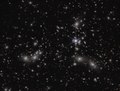
English: Astronomers estimate 50,000 sources of near-infrared light are represented in this image from NASA’s James Webb Space Telescope. Their light has travelled through varying distances to reach the telescope’s detectors, representing the vastness of space in a single image. A foreground star in our own galaxy, to the right of the image center, displays Webb’s distinctive diffraction spikes. Bright white sources surrounded by a hazy glow are the galaxies of Pandora’s Cluster, a conglomeration of already-massive clusters of galaxies coming together to form a megacluster. The concentration of mass is so great that the fabric of spacetime is warped by gravity, creating an effect that makes the region of special interest to astronomers: a natural, super-magnifying glass called a “gravitational lens” that they can use to see very distant sources of light beyond the cluster that would otherwise be undetectable, even to Webb.
These lensed sources appear red in the image, and often as elongated arcs distorted by the gravitational lens. Many of these are galaxies from the early universe, with their contents magnified and stretched out for astronomers to study. Other red sources in the image have yet to be confirmed by follow-up observations with Webb’s Near-Infrared Spectrograph (NIRSpec) instrument to determine their true nature. One intriguing example is an extremely compact source that appears as a tiny red dot, despite the magnifying effect of the gravitational lens. One possibility is that the dot is a supermassive black hole in the early universe. NIRSpec data will provide both distance measurements and compositional details of selected sources, providing a wealth of previously-inaccessible information about the universe and how it has evolved over time. |
| Data | 15 de fevereiro de 2023 (data do carregamento) |
| Origem | Pandora's Cluster (NIRCam Image) |
| Autor | SCIENCE: NASA, ESA, CSA, Ivo Labbe (Swinburne), Rachel Bezanson (University of Pittsburgh) IMAGE PROCESSING: Alyssa Pagan (STScI) |
| Outras versões |
|
.jpeg)


_(2023-107).png)
_(2023-107).png&flash=no)
Licenciamento

|
This file is in the public domain because it was created by NASA, ESA and CSA. NASA Webb material is copyright-free and may be freely used as in the public domain without fee, on the condition that only NASA, STScI, and/or ESA/CSA is credited as the source of the material. This license does not apply if source material from other organizations is in use. The material was created for NASA by Space Telescope Science Institute under Contract NAS5-03127. Copyright statement at webbtelescope.org. For material created by the European Space Agency on the esawebb.org site, use the {{ESA-Webb}} tag. |
 |
Histórico do ficheiro
Clique uma data e hora para ver o ficheiro tal como ele se encontrava nessa altura.
| Data e hora | Miniatura | Dimensões | Utilizador | Comentário | |
|---|---|---|---|---|---|
| atual | 18h16min de 28 de fevereiro de 2023 | | 17 644 × 13 422 (186,09 MB) | wikimediacommons>OptimusPrimeBot | #Spacemedia - Upload of https://stsci-opo.org/STScI-01GQQF9WVPFVMCVHRZY54N2TAR.png via Commons:Spacemedia |
Utilização local do ficheiro
Não há nenhuma página que use este ficheiro.
_(2023-107).png)